
Your local business isn’t losing revenue because the service is worse.
At least, that’s probably not the case.
Most of the time, the problem is a lot simpler: Google is handing the click, the call, the direction request, and the booking to somebody else first. And you’re letting it.
You’re missing just how valuable local search really is.
When someone searches for a plumber, dentist, med spa, or lawyer “near me”, they’re not casually browsing. They’re already deep in a buying moment, and Google is making a fast call on which businesses are worth showing.
How it makes that decision is easy to misunderstand. Google says it’s all about relevance, distance, and prominence. But if you work in this industry for a while, you start to see there’s a lot more to it.
To share a bit more insight, we tested the whole process with a real search for dentists in Costa Mesa.
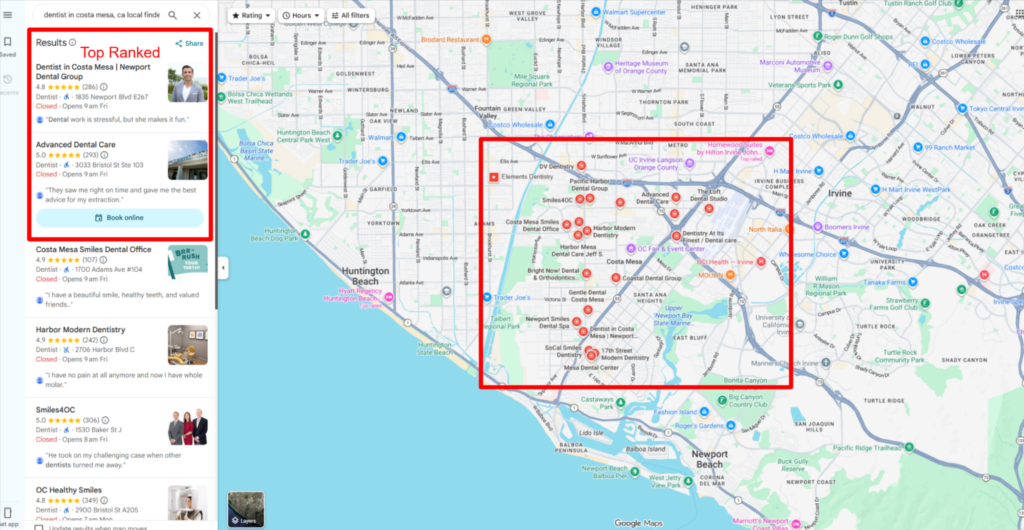
What we saw, very quickly, is that Google wasn’t just rewarding the prettiest website, or the one with the most “history”. It was rewarding the businesses that made their location, category, services, reviews, and booking path painfully easy to understand.
What is Local SEO Is And How Does Google Actually Rank You?
Google Local SEO is the process of helping a business rank in Google Maps, the local pack, and nearby organic results when people search with local intent.
The first thing you’ll probably check if you want to know whether you’re ranking for “Local SEO” is Google Maps. But you can also see results in:
- The local pack
- The local finder
- Localized organic results
- AI-assisted local discovery through things like AI overviews, AI mode, and assistant-style search tools
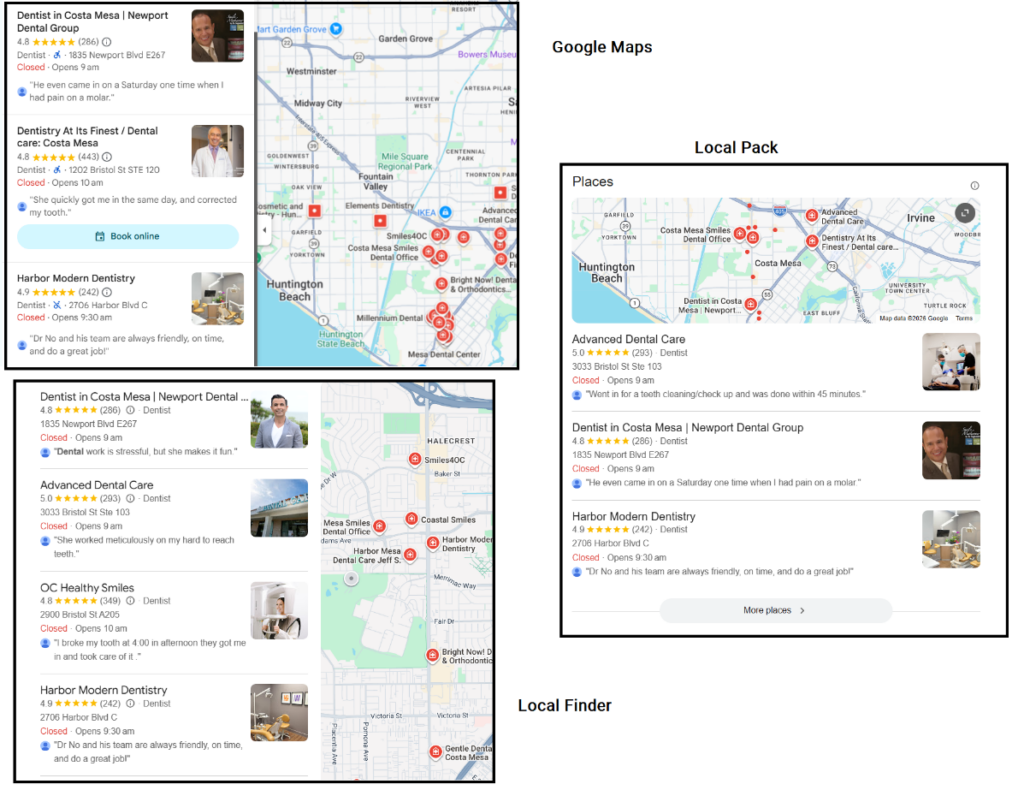
Traditional SEO asks whether a page deserves to rank. Local SEO asks whether a business deserves to be trusted nearby. Ultimately, if Google doesn’t think your business is close enough to be useful, every other optimization has to fight uphill. That’s annoying, but it’s also the reality of local SEO.
A local business needs a believable local entity: the right category, the right address, the right page structure, the right reviews, and enough supporting proof across the web that Google doesn’t feel nervous recommending it.
No matter what you do, your business will only show up inside a practical radius of your physical location. A great site helps. It doesn’t erase geography.
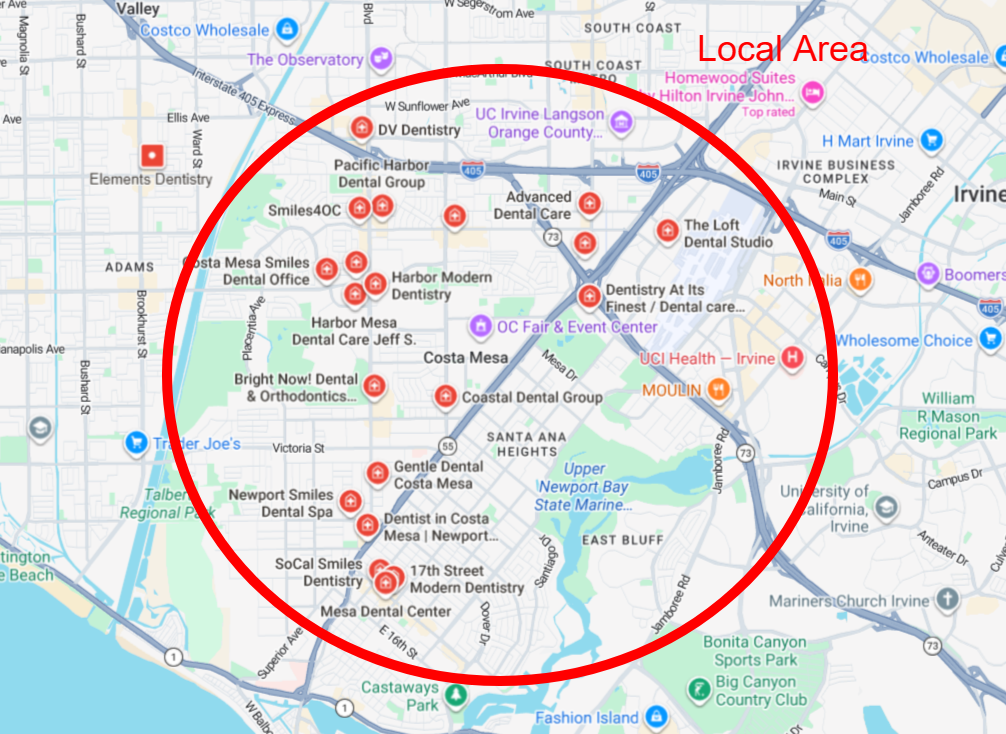
When it comes to defining rankings, Google still says it focuses on relevance, distance, and prominence. That sounds simple, but there’s more to it.
Relevance asks whether your profile, pages, categories, services, and reviews match the query. Distance asks whether you’re close enough to be useful. Prominence asks whether the wider web backs up your claims through reviews, links, citations, mentions, click behavior, and brand proof.
If you dive into the real ranking elements, the top individual factors include the primary GBP category, keywords in the business title, proximity, whether the business is open, ratings, additional categories, text reviews, map-pin placement, review recency, CTR, review growth, and HTML NAP matching the profile.
A polished site can still lose to a competitor with sharper categories, fresher reviews, cleaner NAP, and better proximity. That’s why local SEO feels more practical than glamorous. Google is trying to avoid making a bad recommendation.
A Quick Example of Local SEO In Practice
If you want a quick look at what good Local SEO looks like, here’s a quick overview.
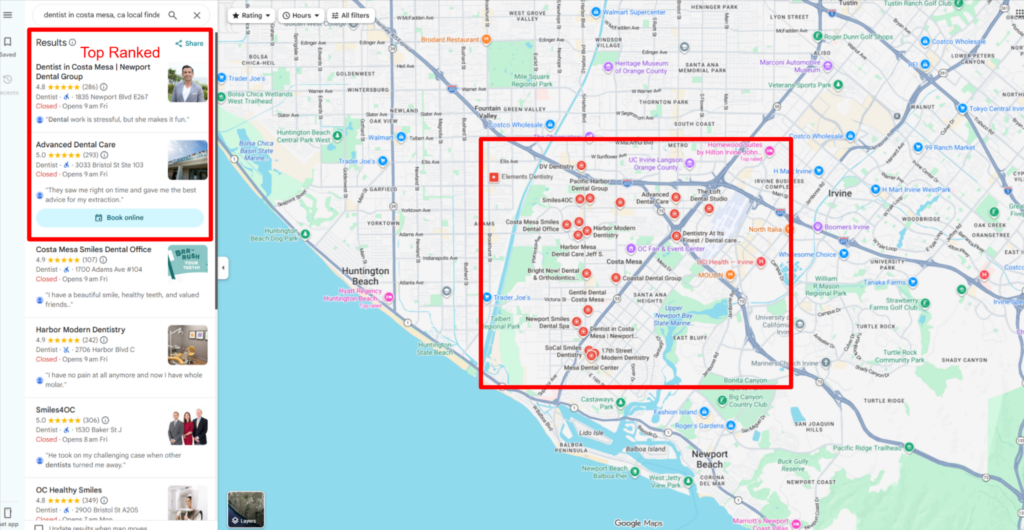
When we searched for “dentist in Costa Mesa, CA” on Google maps, the first result to show up was:
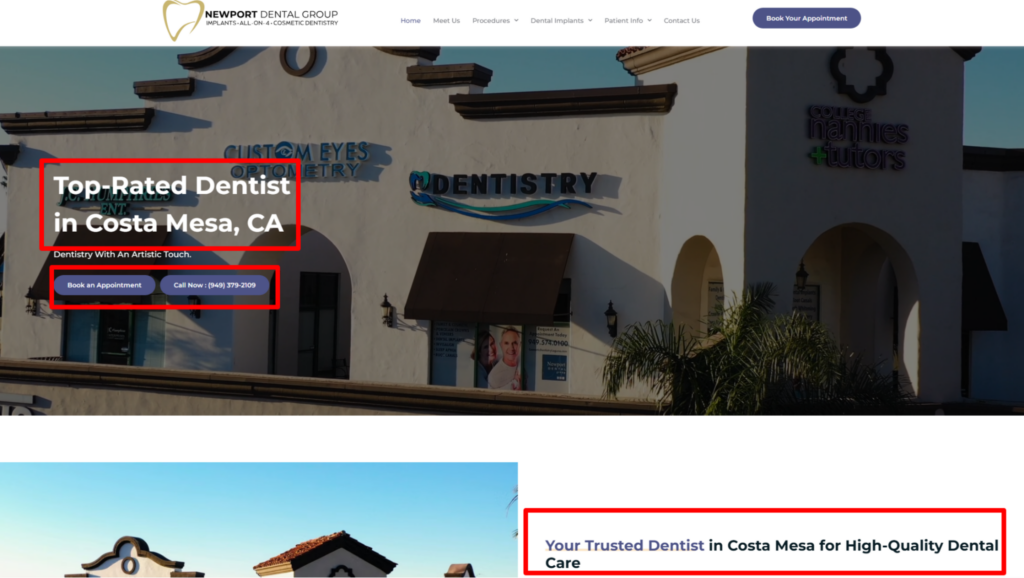
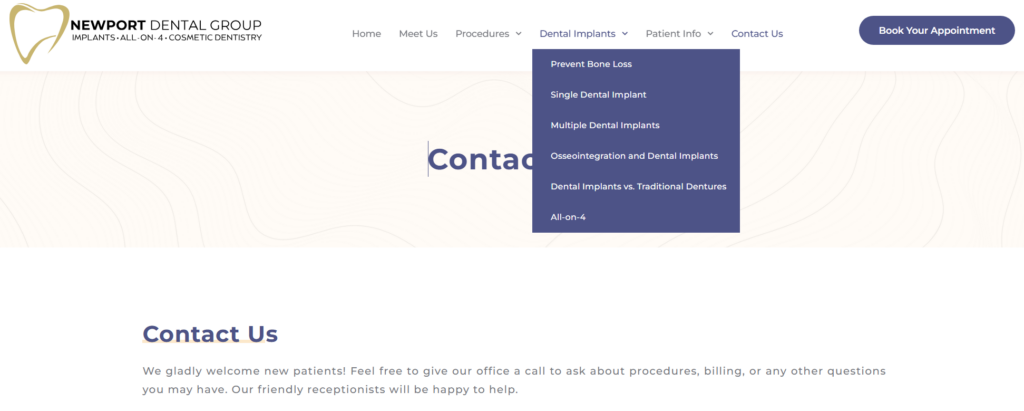
Click through to the website, and this is what you see:
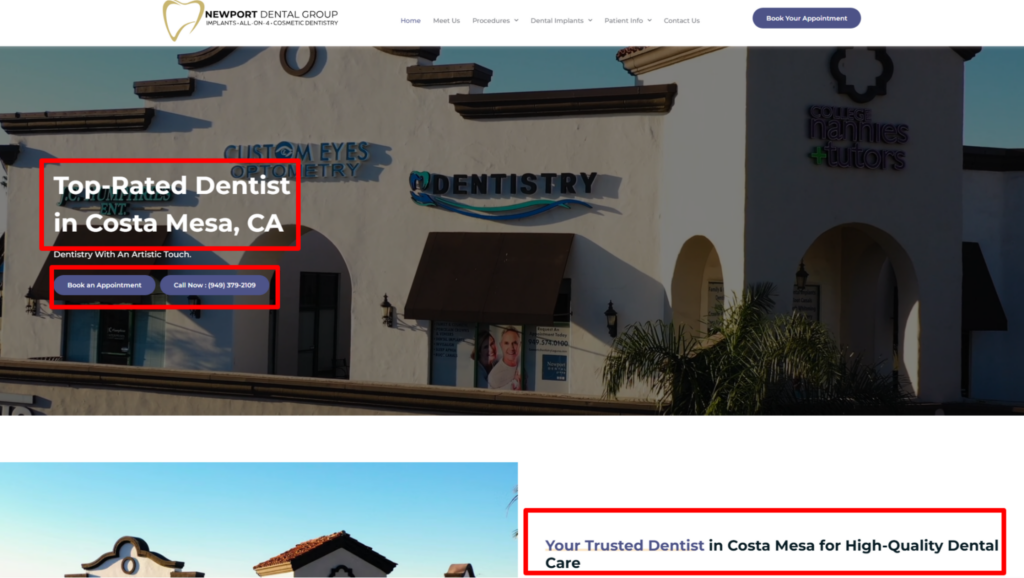
That tells you a lot, straight away. The H1, straight away, mentions Costa Mesa, CA. The first statement you see as you scroll-down the page is localized “Dentist in Costa Mesa”.
When you hover over the tab to check the title tag, once again, you get “Costa Mesa Dentist”:
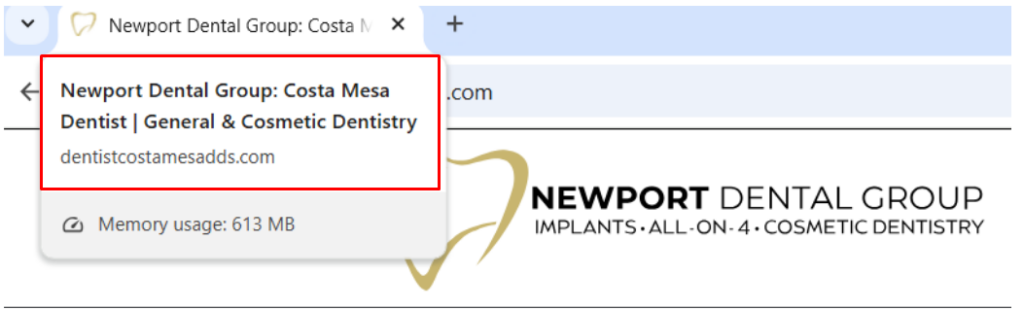
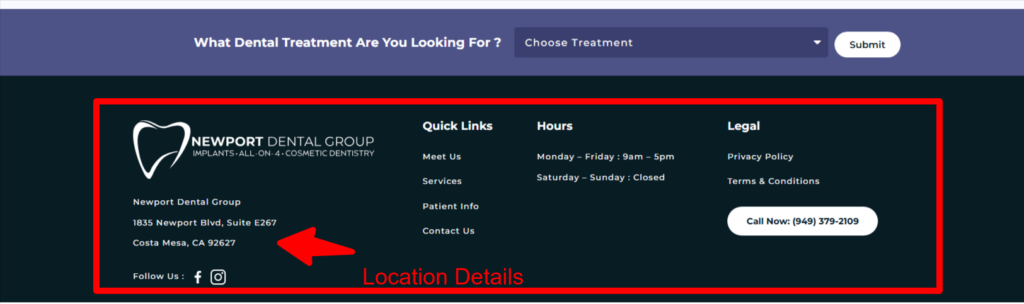
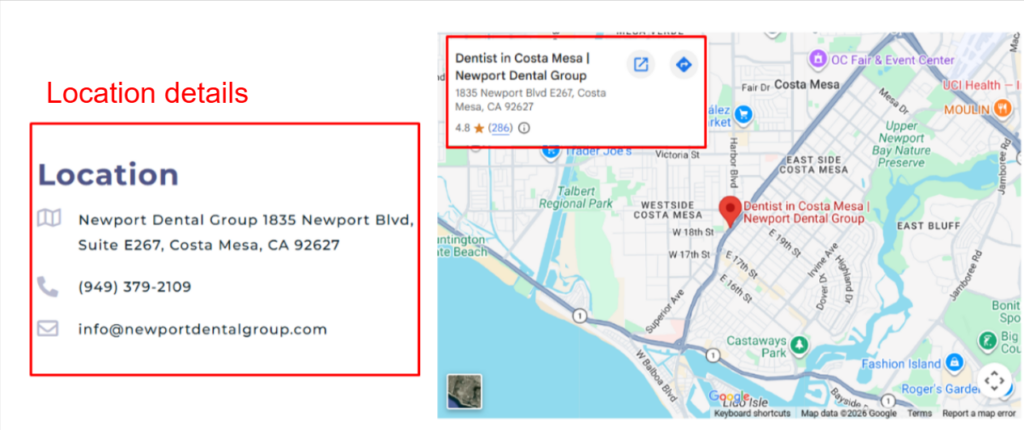
Scroll all the way to the bottom of the page, and you get the full address of the dentist practice, and a Google map embed, too:
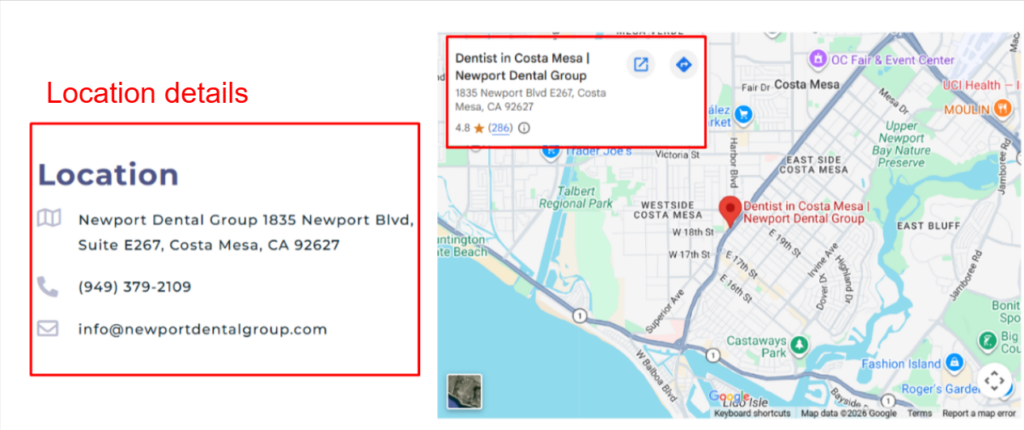
That’s all of your NAP data in one place: phone number, address, contact details. No wonder this practice is ranking.
But that’s just a quick overview. Let’s really get into what’s making this practice number one for local SEO right now, so you can put the strategy into practice yourself.
How To Rank Higher in Google Local SEO
A lot of businesses try to simplify this into: “Just update your Google My Business page”. If that worked, everyone would be ranking without issue, and us SEO experts wouldn’t have a job.
Really, you’ve got to break it down into a few clear steps.
We like to think of this as the “three door” method:
- Door one = GBP verification, NAP, schema, and citations.
- Door two = website structure and how the site connects to the Google Business Profile.
- Door three = authority, reviews, photos, PR, and attribution.
But first, you need your actual market reality.
Step 1: Start with Your Market Reality
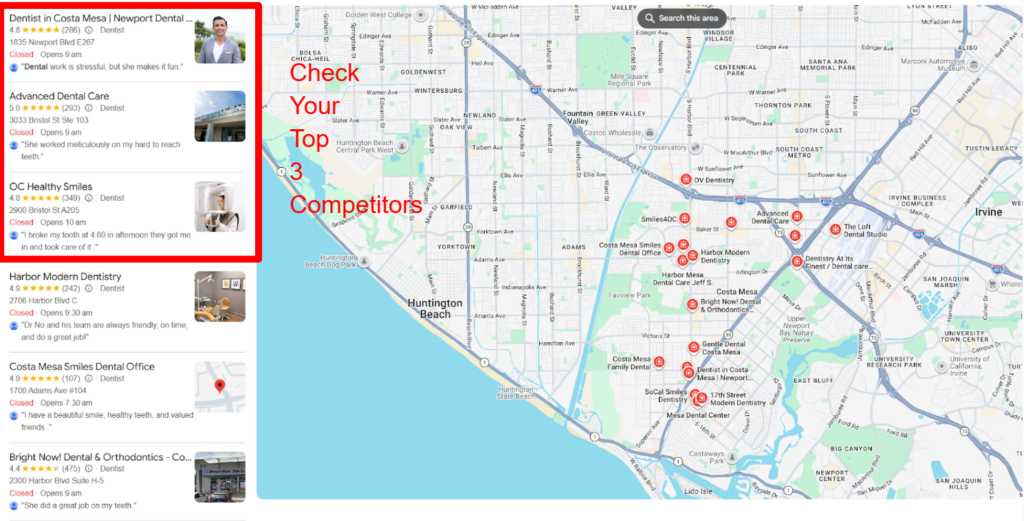
A lot of local SEO advice breaks for one simple reason: it treats ‘the city’ like one flat market. It isn’t.
Google looks at where the search happened, where the business is located, which category it’s in, and which competitors have built the strongest trust in that pocket of demand. Skip market analysis and you can spend months polishing the wrong pages for the wrong geography.
A better starting point is brutally simple:
- Is your address inside the market you want to dominate?
- Which nearby areas are realistic targets?
- Where will Maps be easier than organic, and where will organic be easier than Maps?
- Which competitors keep showing up across the grid, not just in one screenshot?
A really useful strategy? Talk to the market before you optimize for it.
Poll the community. Run a small survey. Ask the front desk what people keep calling about. Mine competitor reviews. Join local business associations. Talk to longtime locals. Even become a customer of your competitors if you need to.
If local demand doesn’t exist, rankings won’t save the business.
Keep in mind, you only show up within a certain radius of your physical location. That matters because weak advice still sells the fantasy that enough SEO can make distance irrelevant. It can’t.
Strong local SEO improves your odds inside the territory where Google already considers you plausible. It can help on the edges. It can help adjacent-city organic visibility. It can’t turn one office into a believable result everywhere in a metro.
That’s why a single-location plumber can build useful nearby-city pages and still struggle to crack the top map spots in those towns. That’s not failure. That’s geography doing what geography does.
The Competitor Analysis Element
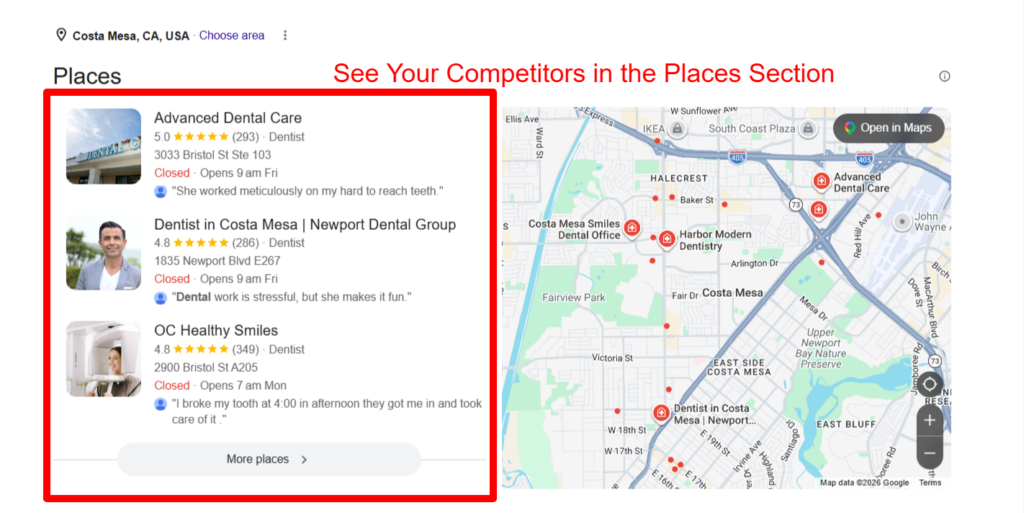
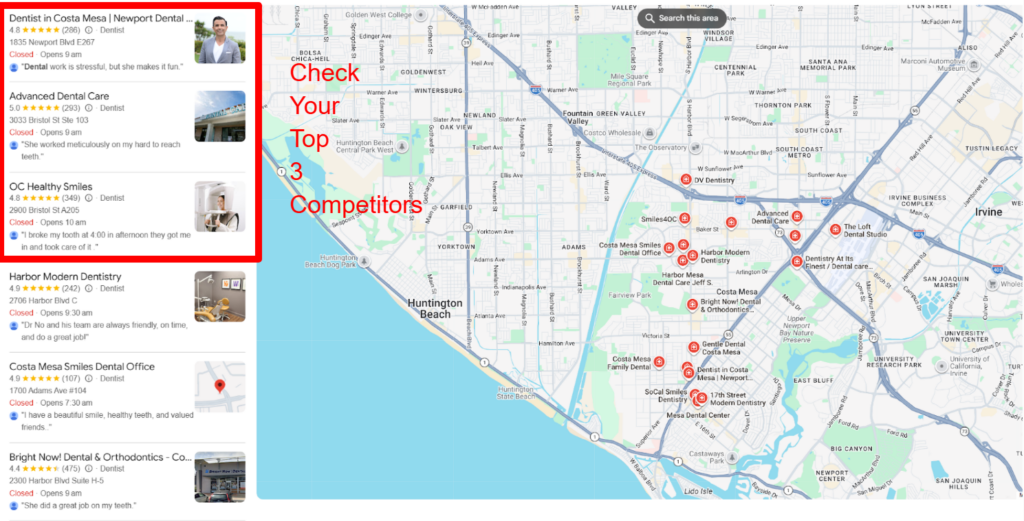
Competitor analysis is easy with manual search. Just add the town or city name you want to rank in to the key term you want to rank for and see what comes up. But don’t leave it there.
Drive a little further away from the most “obvious” competition.
Your real competitors aren’t always the brands you worry about offline. They’re the businesses Google keeps rewarding in the exact areas and query types that matter to you.
Audit competitors across:
- Primary and secondary GBP categories (Kids dentist, family dentist, advanced dentist)
- Review count, recency, and review language
- Office location
- Service pages and location pages
- Internal linking
- Local backlinks and mentions
- Citation consistency
- Booking flow and conversion path
Use tools if you have them. Ranking grids, local rank trackers, and keyword-gap tools make it much easier to see where visibility falls off, which services are underrepresented, and which nearby markets deserve a page instead of a guess.
Do one dead-simple manual check too. Search your core term from your office, then from another part of town, then from a nearby city. You’ll usually watch the pack reshuffle in real time. That’s the quickest way to feel how much the searcher’s location changes the market.
A business can still outrank you because its category is cleaner, its office is closer to the search point, its profile is more complete, or its reviews mention the exact services people search for. Sometimes adding a few of the simplest details, like the type of parking you have, can sharpen relevance.
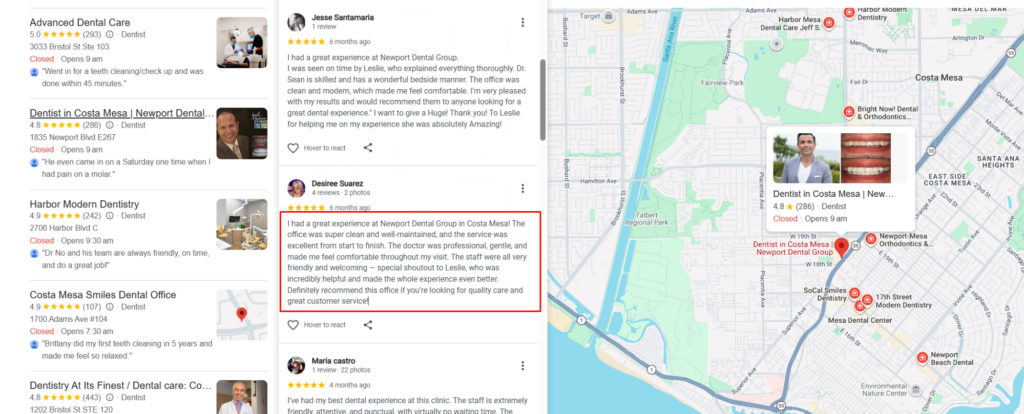
We found that reviews that mention parking, dental implants, less pain, or a convenient shopping-center location can sharpen relevance for long-tail local searches. That’s the kind of detail generic SEO advice usually misses.
Door One: GBP, NAP, Citations, Categories, Compliance, And Your Source-Of-Truth Record
Google Business Profile optimization is the foundation of local search because the profile is often the first thing Google and the customer see, judge, and click.
If the website is the showroom, the Google Business Profile is the storefront window people actually stop at first.
That’s why profile quality keeps showing up as the heaviest local pack factor. A strong profile needs:
- The right primary category
- Relevant secondary categories
- Accurate hours
- The correct website URL
- A direct booking link where appropriate
- Complete service information
- Real photos
- Active review management
- A description that matches the real business
You’re not done just because you’ve “verified” your profile.
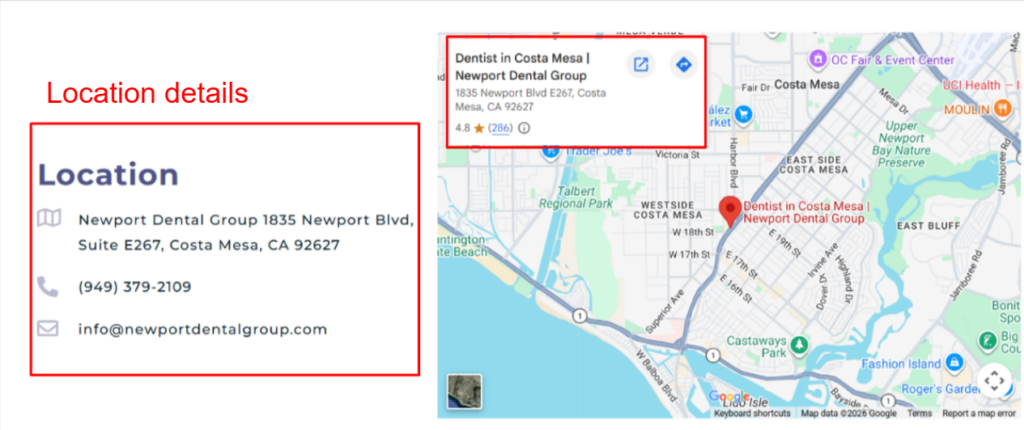
Verification is only the start. Once the profile is verified, the same business name, address, and phone number need to show up on the homepage, contact page, footer, and schema markup. Otherwise, you’ve technically got a profile, but you haven’t really built trust around it.
How Do You Ensure NAP Consistency for Google Local SEO?
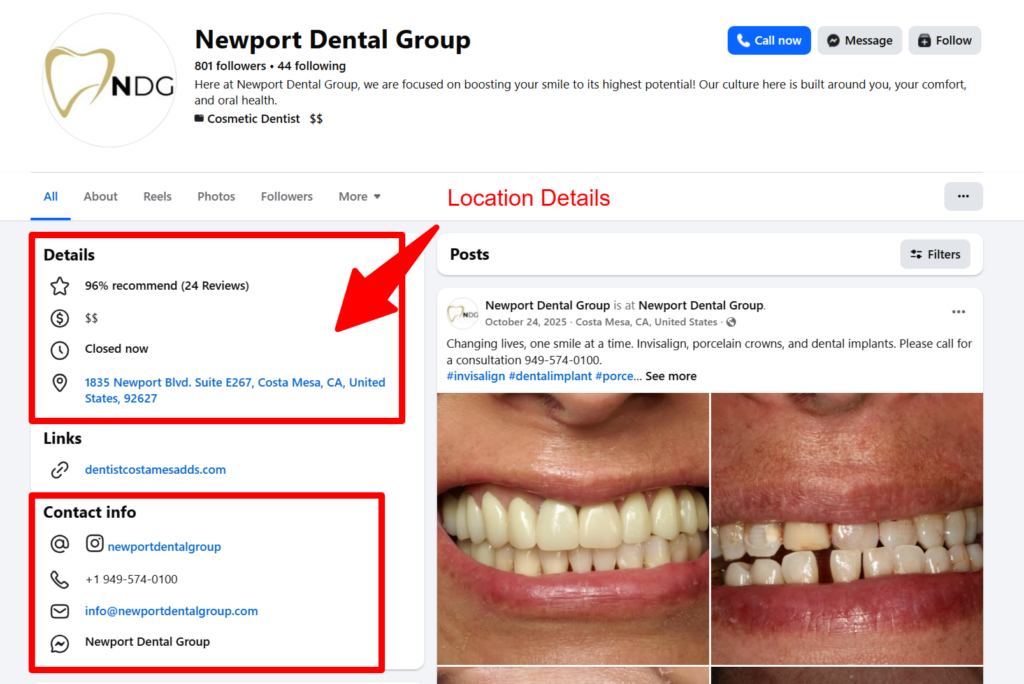
NAP consistency still matters, and yeah, it sounds boring.
But it can also ruin everything if you ignore it.
If your Google Business Profile says one thing, your website footer says another, and some old directory still has a phone number from two years ago, Google has to decide which version of your business is real. That’s the problem. You’re introducing doubt for no reason.
And customers feel it too. They don’t think, “Ah, interesting, this business has inconsistent local signals.” They just think, “Why is this number dead?” or “Wait, is this the right location?”
That’s the real issue here. NAP consistency isn’t just about feeding Google clean data. It’s about making the business feel stable wherever somebody finds it.
Where your NAP needs to match
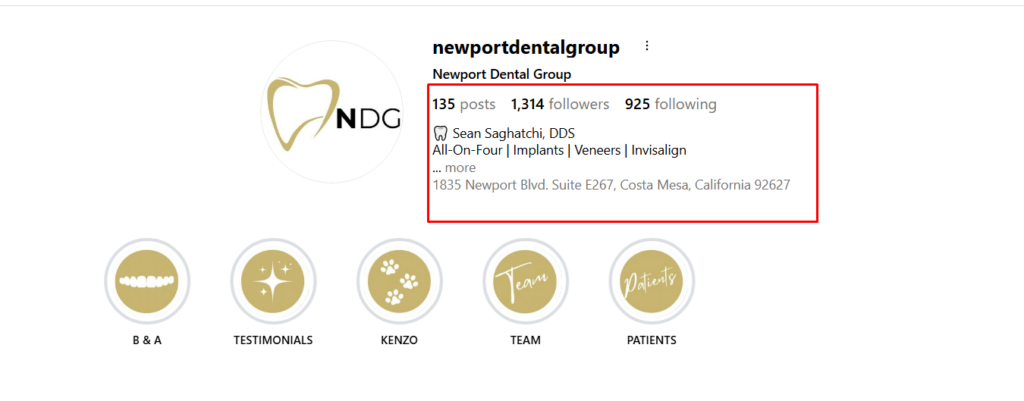
At a minimum, your core business details should line up across:
- Google business profile
- Homepage
- Contact page
- Footer
- Location pages
- Schema markup
- Major local directories
- Major industry directories
If you’ve got multiple locations, it gets even easier to make a mess. One office page ends up showing another office’s number. Two profiles point to the same page. Somebody updates the address in one place and forgets the other four. It happens constantly.
Common NAP Mistakes
Most NAP problems are tiny on their own:
- old phone number in the footer
- suite number included on one page and missing on another
- brand name written one way on the profile and another way on the site
- location page using the wrong office details
- old hours on a directory listing
- schema that never got updated after a move
One of those? Probably survivable. Six of those? Now your local setup starts looking messy.
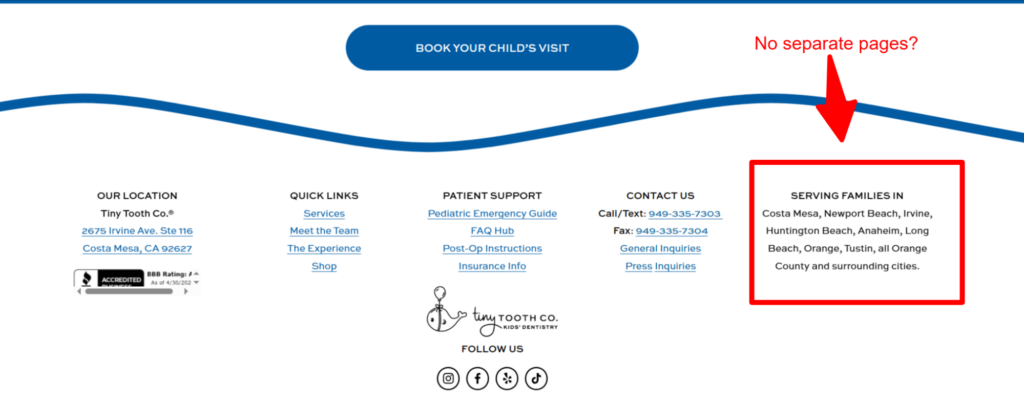
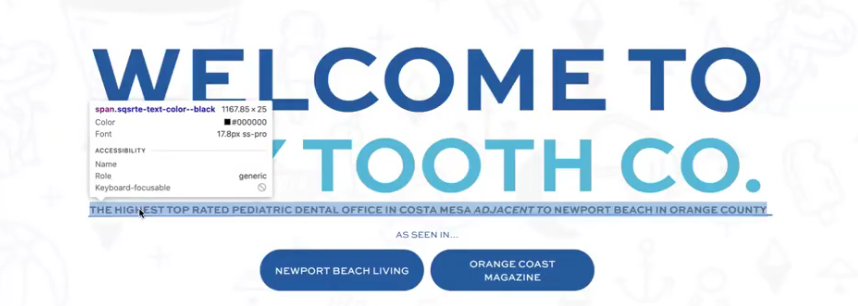
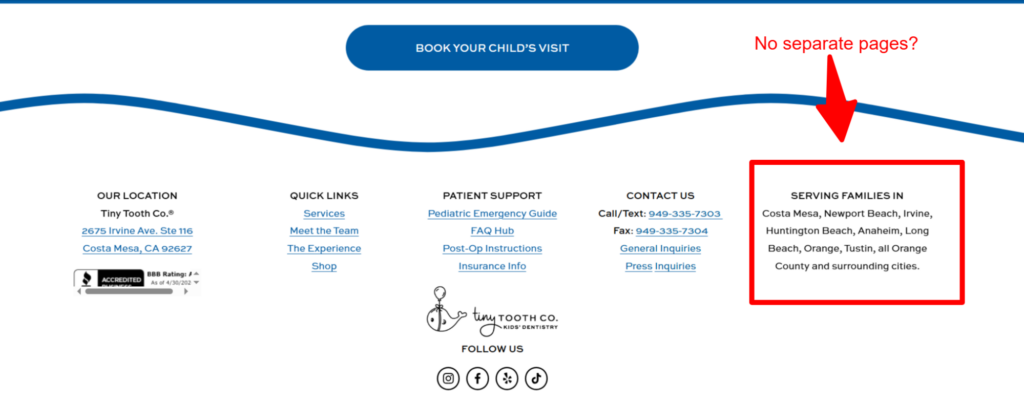
Look at Tiny Tooth Co, here. They’ve done some of the work for local SEO optimization, address and phone number for instance, but there’s not enough consistency. They’re missing the map embed, there’s no title tag, and even when the company does mention its location on the home page, it’s not in the header, which means the company isn’t getting the full “juice” out of the reference.
The One Source of Truth Record
The easiest solution? Keep one source of truth record for every location.
| Field | What to include |
| Business name | The exact business name used on your Google Business Profile and website |
| Address | The full physical address for that location, formatted consistently everywhere |
| Phone number | The main local phone number |
| Text number | The SMS number, if the business uses one |
| Hours | Standard opening hours, plus any special or seasonal hours |
| Categories | Primary Google Business Profile category and all relevant secondary categories |
| Short description | A concise business summary for listings and profiles |
| Long description | A fuller business description for pages, profiles, or directory listings where space allows |
| Attributes | Relevant business attributes, such as accessibility, amenities, service options, or payment types |
| Services | The core services offered at that specific location |
| Booking URLs | Direct appointment, booking, quote, or reservation links |
| Photos and videos | Approved media files for that location, including storefront, staff, services, and branded visuals |
| Social profiles | Links to the business’s active social media accounts |
| Location page URL | The exact URL of the matching location page on the website |
This source-of-truth record should feed more than the website. It should feed schema markup and citation building too. Schema SEO code and citations are the places where the same NAP message gets repeated across the internet. That’s exactly how this record earns its keep.
How to Build Local Citations for Google Local SEO
Think of citations as repetition with a purpose.
When Google keeps seeing the same name, address, and phone number in credible places, the business starts to look more settled. It’s not glamorous work. It’s trust-building work.
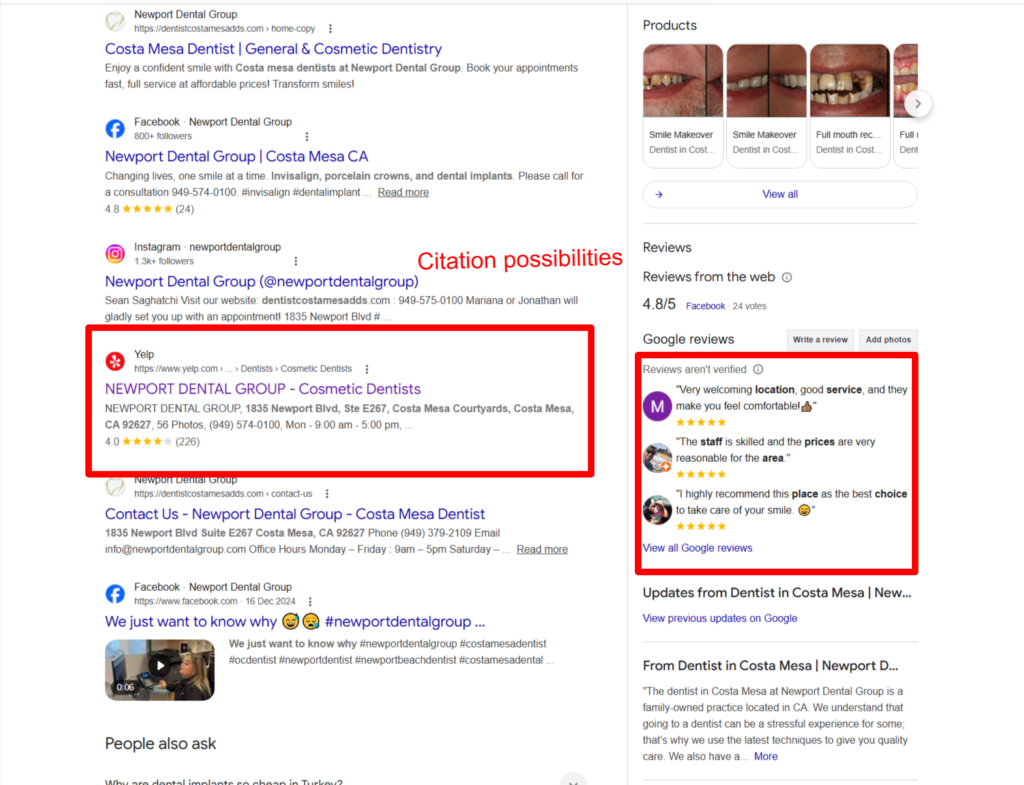
The job of citations isn’t to magically boost your ranking.
Their job is to reinforce the same business identity across the web. That’s it.
A citation is any listing or mention that includes some combination of your business name, address, phone number, and website. It might also include opening hours, or a description.
That can show up on:
- Major business directories
- Industry directories
- Chamber pages
- Local business associations
- City or neighborhood business portals
- Supplier pages
- Community listings
The Order You Should be Getting Citations In
A lot of businesses go straight into bulk-submission mode and create more mess than they solve.
The smarter order is:
- Core directories first
- Industry citations next
- Local/community listings after that
- Duplicate cleanup the whole way through
That way you’re building on something stable instead of spraying inconsistent data everywhere.
What good citation work looks like
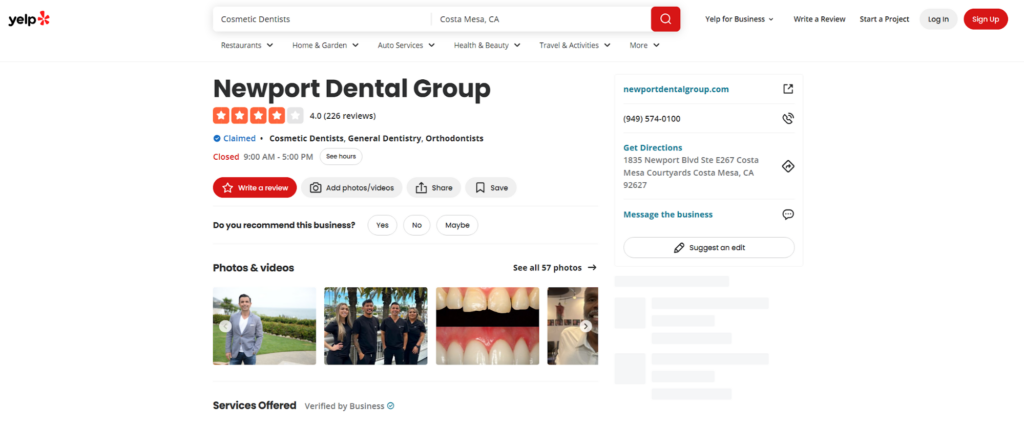
Good citation work usually means:
- The business details are accurate
- The category makes sense
- The description matches what the business actually does
- The website link points to the right page
- The listing exists somewhere a real person might use
Choosing Categories For Google Local SEO
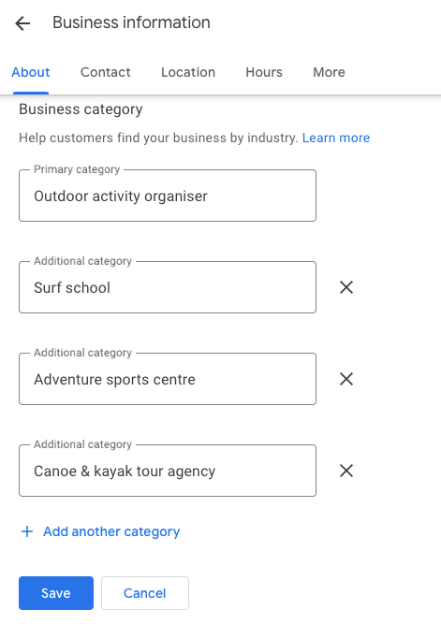
Category choice is one of those local SEO details that looks small until it quietly wrecks your relevance.
If the business really wants more pediatric-dentistry patients, but the profile is still leaning broad under general dentistry, Google gets a softer, blurrier signal than it should.
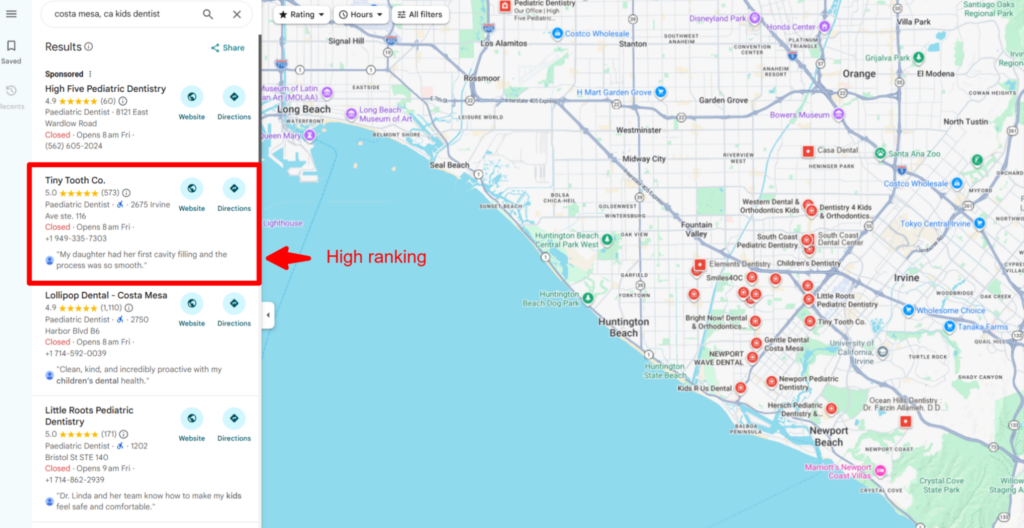
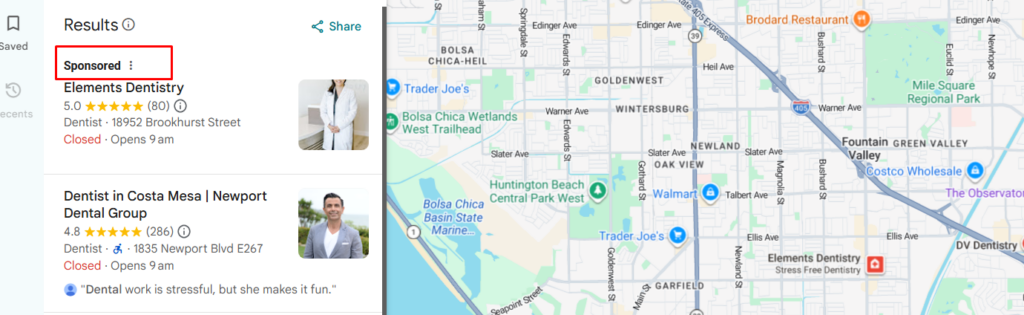
Look at Tiny Tooth again here, they’re clearly focused on children’s dentistry, and in this case, it looks like they got their category right, because they show up first for “pediatric dentist” on Google maps, under the sponsored listings, of course.
A good category setup should:
- Tell Google the main service clearly
- Support legitimate sub-services
- Match how people actually search
That first category matters a lot. The supporting categories matter too, but they’re there to back up the main picture, not muddy it. Usually it goes wrong when someone picks something too broad, adds too many loosely related category, and focuses on trying to cover “everything.”
The easiest way to audit categories is to ask:
- What service do we actually want more of?
- Is the primary category saying that clearly?
- Do the secondary categories reflect real services?
- Do the website, reviews, and profile all reinforce the same idea?
If the answers start drifting apart, the category setup probably needs work.
Core Policies Matter More Than Most Businesses Think
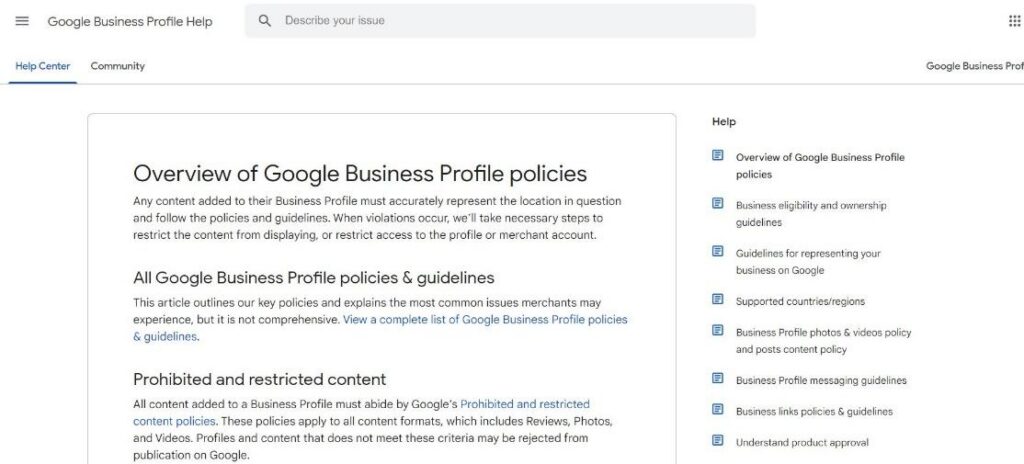
This is one of those points people skip because it feels operational, not “SEO.”
Big mistake. If your refund terms, cancellation rules, service-area boundaries, or even parking instructions are hard to understand, that affects everything.
The things worth making painfully clear are:
- Cancellation and rescheduling terms
- Refund or return policies
- Financing and payment options
- Service-area boundaries
- Emergency or after-hours expectations
- Parking and access details
- Accessibility information
- Booking instructions
When those are clear, you usually get fewer confused calls, bad-fit bookings, preventable complaints, and bad reviews.
Imagine, for instance, a local clinic has:
- One version of its name on the profile
- A slightly different version in the footer
- A missing suite number on the contact page
- Outdated hours in a directory
- The right service focus on the site
- A weaker category on the profile
- Fuzzy cancellation and payment details
Nothing is broken in some dramatic, obvious way. But the whole thing feels a little off.
Search engines get a weaker identity signal. Customers hit little bits of friction. Calls get messier. Reviews soften. Conversions wobble.
Even something as simple as opening hours can affect visibility more than people realize. If a business is closed when the search happens, that can change how competitive it is for certain local-intent queries in that moment.
Door Two: Website Architecture And Local Landing Pages
A lot of local sites still look like brochures: polished homepage, vague services page, one contact page, and not much else. Looks fine on the surface. Doesn’t help Google much.
How should you structure a local SEO website?
Your site should reflect how the business actually works. If you’ve got multiple offices, core services, or practitioners, the site should make that obvious fast. When the homepage, service pages, location pages, and booking paths all blur together, Google has to guess, and so do your customers.
A solid local site usually has:
- A homepage that clearly explains the business and main market
- Separate pages for each core service
- Separate pages for each physical location
- Contact, about, and review/testimonial pages
- Practitioner or department pages where relevant
- Nearby-city or service-area pages only when there’s a real reason for them
- A clear booking or contact path from every important page
Should Each Location Have Its Own Page?
Yes. If you’ve got multiple offices, each one should have its own page. The transcript makes that point clearly: one office, one page, one Google Business Profile.
Each location page should include:
- The exact business name, address, and phone number for that office
- The services offered there
- Unique local copy
- Parking, access, or driving details if they matter
- Local proof, like reviews or project examples
- A google map embed
- A strong CTA
A simple example: if a dental group has Costa Mesa and Newport Beach offices, both profiles shouldn’t point to the homepage. Each office needs its own page, its own local context, and its own conversion path. That’s cleaner for users and for Google.
Should Each Service Have Its Own Page?
If people search for it and it matters commercially, yes.
This is where businesses leave money on the table. They dump ten services onto one page, then wonder why Google can’t tell what should rank. Build separate service pages and link to them from the right location pages.
A strong service page usually has:
- A clear title tag
- A clear H1
- A short intro that says what the service is
- Proof that builds trust
- A CTA
- Links back to the right location page
The good news: those pages don’t need to be long. They need to be clear. A focused 200-word page can work when the title tag, H1, headings, and internal links are clear. The page doesn’t need to be huge. It needs to be obvious.
Can Nearby-City And Service-Area Pages Work Without An Office There?
Yes, but they’ve got to be honest.
A service-area page isn’t the same as a location page. A location page is tied to a real office. A service-area page proves you serve that place even if the office is elsewhere.
Good service-area pages usually include:
- Proof you really serve that area
- Examples, testimonials, or jobs from that market
- Service details tailored to local demand
- A clear connection back to the real office
- A real reason for the page to exist
Bad ones are just city-name swaps.
How should you link your Google Business Profile?
For a single-location business, the homepage is usually fine. For a multi-location business, each profile should point to the matching location page.
That helps because it:
- Strengthens the profile-page relationship
- Sends users to the right office
- Makes tracking cleaner
If a local profile sends people to a generic homepage, both Google and the customer have extra work to do.
Why Do Headings, Schema, And Internal Links Matter?
Because Google can’t rank a design file. It reads structure.
A page can look locally optimized to humans and still miss the structural signal Google reads. That’s exactly what happened for Tiny Tooth example. The page uses strong pediatric/Costa Mesa wording visually, but the inspected element isn’t a true header, so the page isn’t getting full SEO value from the phrase. It looks right. It just isn’t working hard enough.
A clean page usually looks like this:
- H1: main service plus main location
- H2s: who it’s for, what it includes, why choose this provider, FAQs, booking info
- H3s: supporting details underneath
Schema matters too. Name, address, phone number, hours, URL, and related local details should support what’s already visible on the page, not contradict it.
Internal links matter for the same reason. Location pages shouldn’t sit there like islands. They should connect to the services that office actually offers.
How Important Are Mobile Usability And Technical Cleanup?
Very. Local intent is often mobile intent. If the page loads slowly, the form breaks on a phone, or the page is hard to use on mobile, rankings and conversions both take a hit.
The technical stuff that gets ignored most often:
- Broken internal links
- Noindex mistakes
- Slow mobile pages
- Duplicate location URLs
- Broken forms
- Oversized images
- Pages that are hard to crawl
None of that sounds exciting. It still kills performance.
Door Three: Reviews, Photos, and Reputation Management: The Trust Signals People And Google Both Read
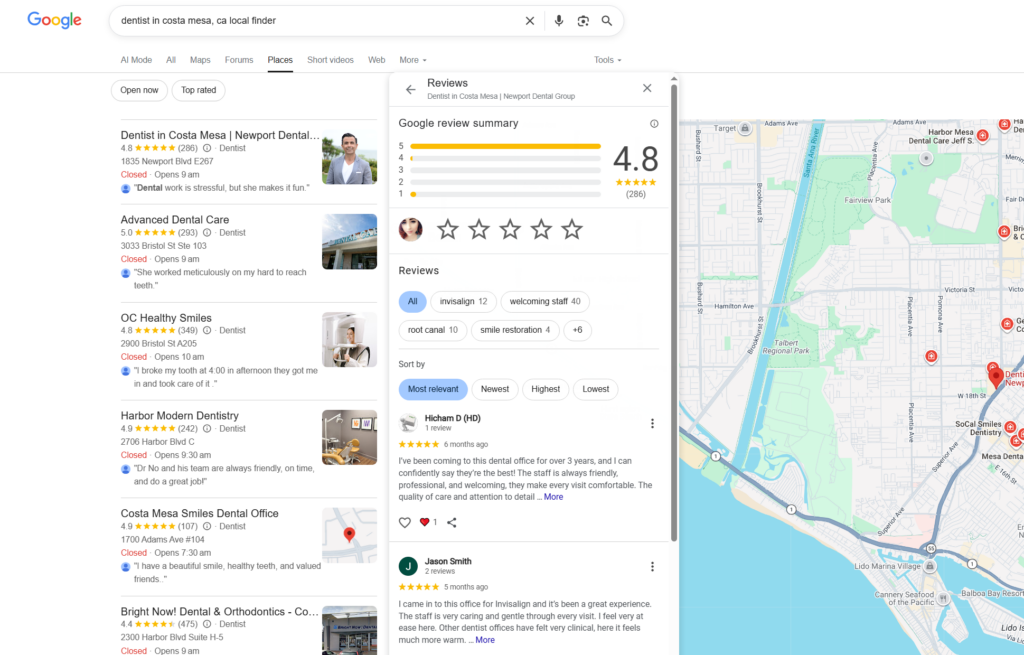
Reviews do two jobs at once. They shape how Google reads the business, and they shape how a real person judges it in a few impatient seconds.
That’s why Google Business Profile optimization lives or dies here. Better reviews don’t just help after the click. They make the profile look stronger before the click.
The signals that matter most are:
- Star rating
- Review recency
- Steady review growth
- Text detail inside the review
- Owner responses
- Review photos
A clinic with 180 reviews spread across three years can still look weaker than a competitor with fewer reviews but a better recent flow, more detailed treatment mentions, and active responses.
Real Reviews Matter Most
One quick tip. Google’s fake-review rules are real, and the penalties are not subtle. If a profile benefits from fake engagement, Google says it can:
- Block new reviews or ratings for a period
- Temporarily unpublish existing reviews or ratings
- Show a warning that fake reviews were removed
That’s rough. And honestly, it should be.
Do this instead:
- Ask real customers for honest reviews
- Make the review process easy
- Use a direct link or QR code
- Don’t script keywords into their mouth
- Don’t buy reviews
- Don’t have staff or friends leave fake ones
- Don’t offer incentives that break the rules
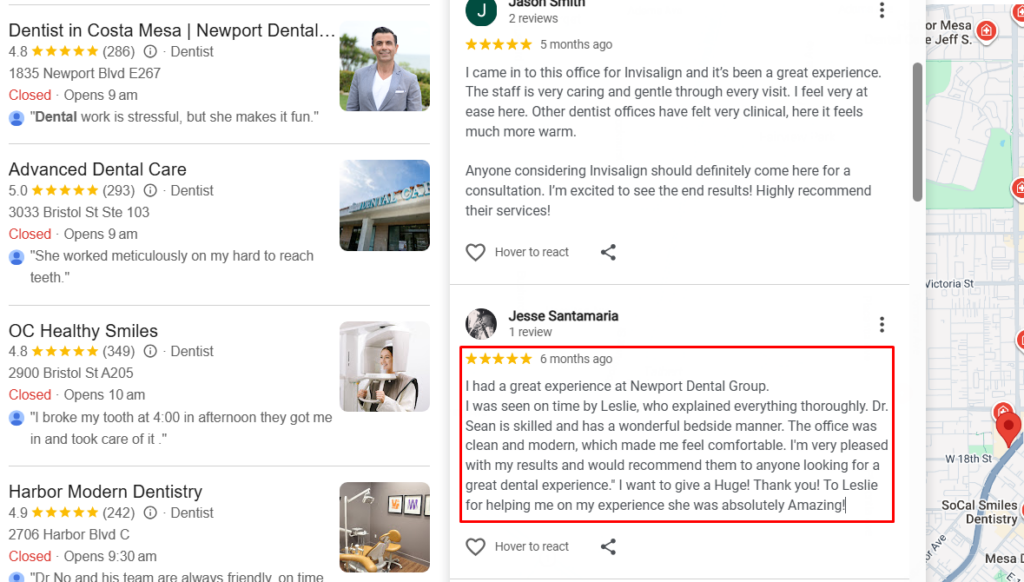
No manipulation needed. You can see in the example above that the top-ranking dentist here has clearly authentic reviews. They’re detailed, the explain the full experience, they reference specific staff members. That’s hard to fake.
Do Keywords In Reviews Help Local Rankings?
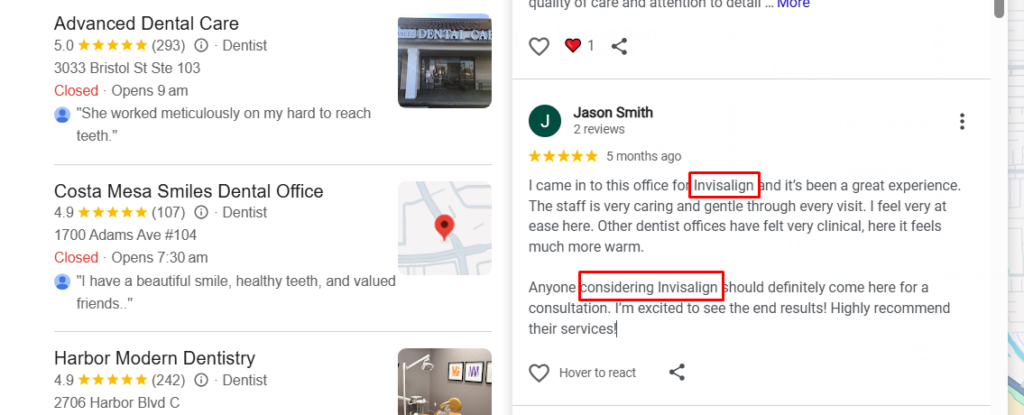
Yes, when they show up naturally.
A review that says ‘great dentist’ helps trust. Fine. But a review that says the patient came for dental implants, Invisalign, had less pain than expected, found easy parking, or liked the nearby shopping center does a lot more work. It gives Google context and gives the next customer a reason to click.
One extra detail worth adding: Google can also show local justifications in the profile, things like phrases pulled from reviews that reinforce relevance. That makes review wording even more useful when it happens naturally.
How Should Local Businesses Ask for Reviews?
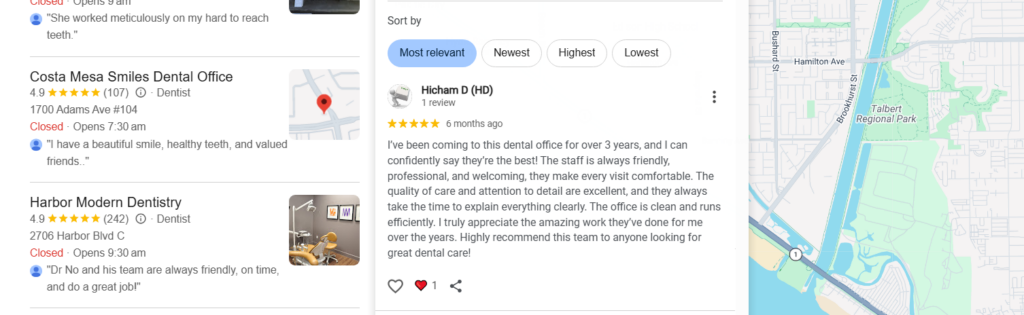
Guide for detail. Don’t dictate wording. reviews with real words help Google know what to show you for. The ask shouldn’t stuff keywords into a customer’s mouth. It should nudge them to mention what genuinely happened.
Better prompts sound like:
- “Would you mind mentioning the service you came in for?”
- “If anything stood out, like parking, wait time, or how the team helped, that context is really useful.”
- “Would you be open to sharing what made you choose us?”
Bad prompts try to stuff keywords into the customer’s mouth.
There’s also a practical workflow here that’s easy to miss. Google officially lets businesses generate a direct review link or QR code, and specifically suggests using it on receipts, thank-you emails, at the end of chat interactions, and as a printed QR code in-store. If you’ve got a counter or waiting room, print the QR code and put it where happy customers will actually see it.
What Kind of Photos Work Best for Local Google SEO?
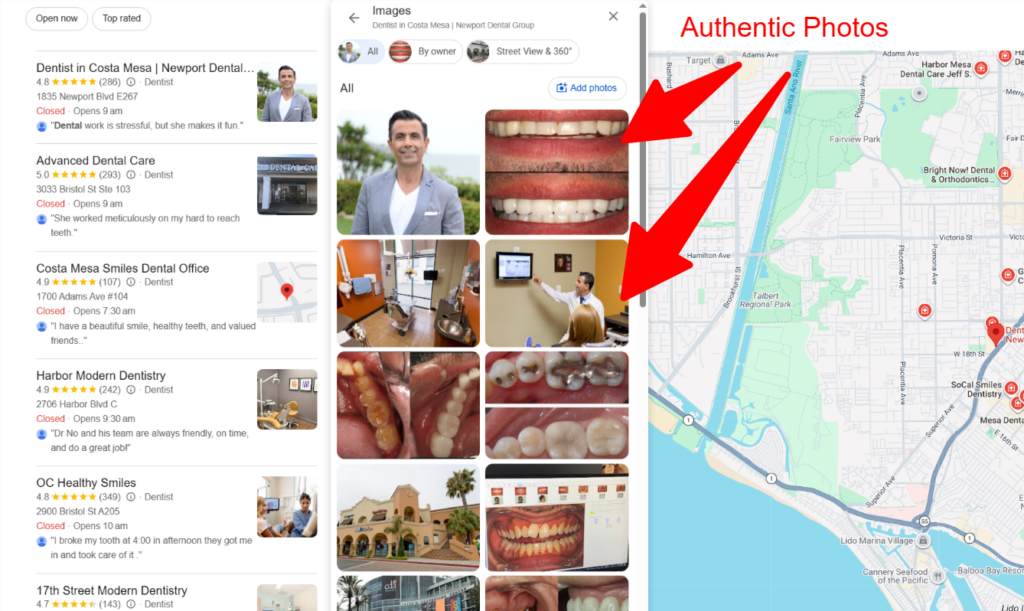
The best profile photos reduce friction.
Google’s own photo guidance says storefront, product, service, and exterior photos help customers recognize and trust the business. The transcript adds the more useful local nuance: show the real place, the real team, the brand name when possible, and recognizable service cues. For a dentist, that might mean scrubs, treatment rooms, signage, and the actual entrance. For a plumber, it might mean branded vans, tools, uniforms, and real job-site shots.
Take the photos on your phone at the real location and upload real-world images, not stock visuals. Show the real location, the real team, the brand name in the background, and cues Google and customers can actually understand: scrubs, treatment rooms, branded vehicles, tools, signage, the entrance. Stock photos won’t do that job.
Useful photo categories:
- Exterior entrance
- Interior front desk or waiting area
- Staff at work
- Treatment or service environment
- Equipment or product setup
- Signage
- Parking or arrival context when that matters
- Before-and-after visuals when appropriate and policy-safe
How Often Should You Add Photos and Updates?
Often enough that the profile never feels stale.
A sensible rhythm looks like this:
- Upload fresh photos every month
- Add new team or storefront photos when something changes
- Update special hours immediately
- Post when something real happens: a new service, event, seasonal offer, equipment upgrade, or location update
Google also notes that customers can add photo updates to a profile, and businesses can respond to those updates. That matters because the profile isn’t just a static listing anymore. It’s an active surface.
Authority, Local Publishing, E-E-A-T, AI Visibility, Social Proof, Partnerships, And Where Paid Support Fits
First, local links still matter. They’re trust signals with context.
A good local link tells Google something useful: this business is known here, connected here, and relevant here. That matters more than raw link volume in local search. The goal isn’t to spray links at the homepage and hope. It’s to point the right links at the right pages: homepage, location pages, service pages, and sometimes even the Google Business Profile itself.
That’s also why local directories still matter when they’re real. They can reinforce citations and, in some cases, send a legitimate local link at the same time.
So, where should local links point?
| Link type | Best destination | Why |
| Broad brand mention | Homepage | Supports overall authority and brand trust |
| Office-specific mention | Location page | Reinforces that office in that market |
| Service-specific mention | Service page | Strengthens topical relevance for that offer |
| Directory, community, or profile reference | Google Business Profile or matching location page | Supports local entity trust and user discovery |
What Counts As Useful Local Authority?
A few things:
- Local media mentions
- Chamber or association listings
- Supplier or manufacturer references
- Neighborhood partnerships
- Community event pages
- Sponsorships
- Guest pieces on relevant local sites
- Local influencers or creators, if they actually matter in your market.
Local partnerships can be particularly valuable. Work with nearby businesses. Earn references from real organizations. Show up in places your market already trusts. That kind of authority tends to age well.
How Should Local Digital PR Work?
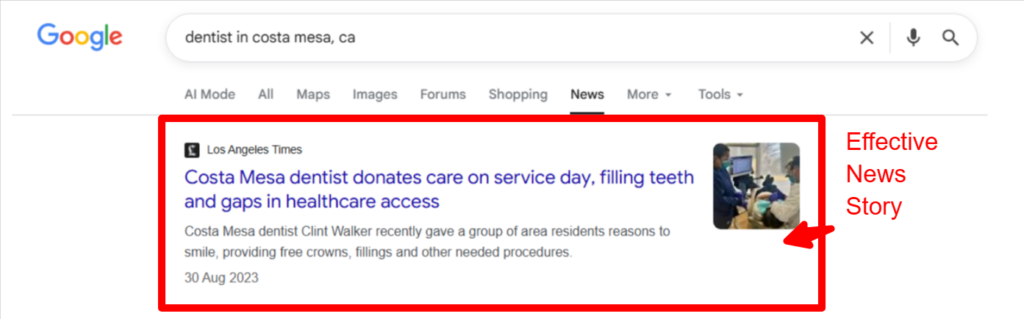
At the local level, digital PR usually just means giving people a real reason to mention you.
Good hooks include:
- Opening a new office
- Launching a meaningful new service
- Running a community event
- Supporting a local charity
- Publishing useful local data
- Commenting on a live local issue.
Press releases, local digital PR, and legitimate local mentions help associate the brand with trusted places in the market. That matters for search now, and it’s only going to matter more as AI tools summarize local options.
What Content Works Best for Google Local SEO?
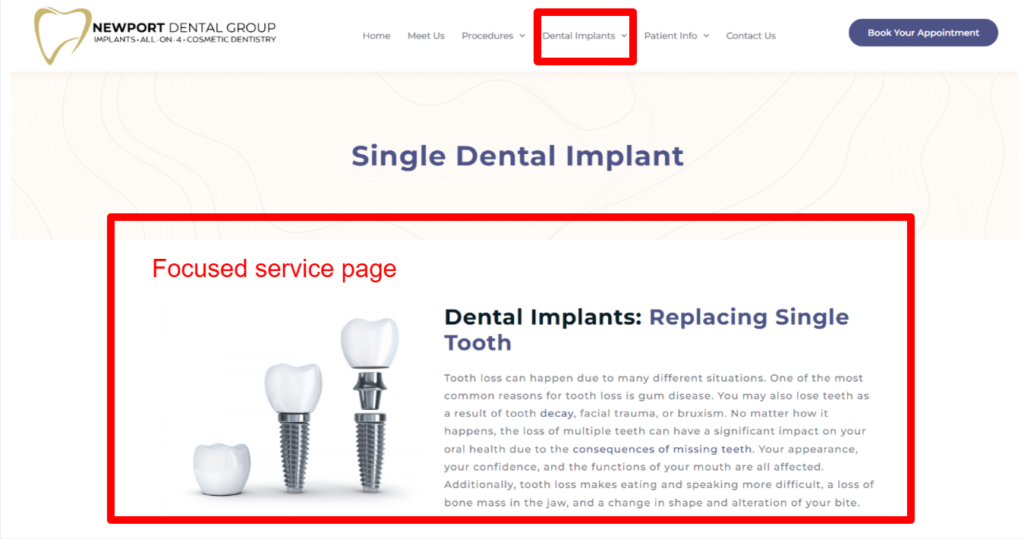
Not every business needs a blog calendar stuffed with filler. Most need a smaller set of pages that answer real buying questions better than competitors do.
These page types usually carry the most weight:
| Page type | What it does best |
| Core service pages | Captures high-intent service demand |
| Location pages | Builds office-specific relevance |
| Nearby-city / service-area pages | Extends organic reach into adjacent markets |
| FAQ pages | Captures question-style searches and supports AEO |
| Pricing / cost pages | Answers high-intent commercial questions |
| “What to expect” pages | Reduces friction before contact |
| Comparison pages | Helps buyers choose between options |
| Case studies / proof pages | Builds trust with real examples |
| Insurance / financing / payment pages | Answers practical conversion questions |
Blogs should be locally relevant. Write about neighborhood events, local problems, service trends in your area, or questions customers keep asking. Generic blogging rarely moves the needle. Local blogging can.
Also check for keyword gaps. Look at the service-plus-city combinations competitors rank for that you don’t. That often reveals missing service pages, missing city pages, weak FAQs, and obvious content gaps.
How Does E-E-A-T Fit Into Local SEO?
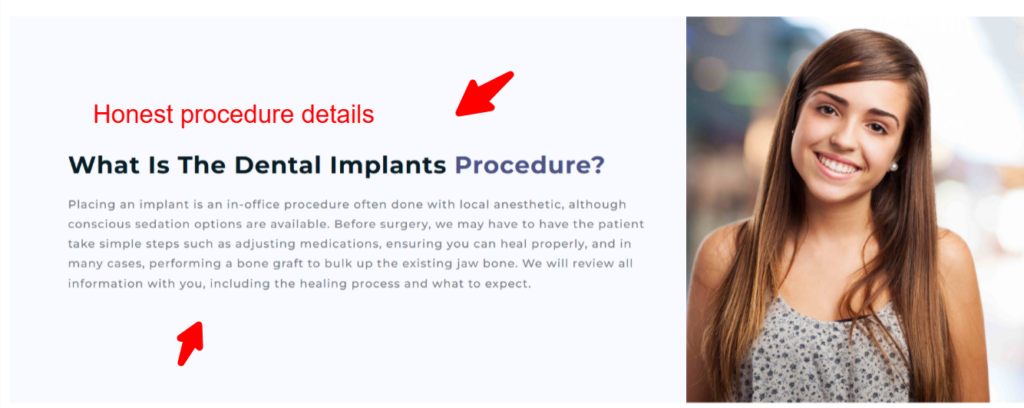
As proof. If your pages read like generic summaries and your proof is thin, Google has less reason to trust you. AI systems won’t trust you either, particularly as more generic stuff floods the web.
Strong local content should show:
- Real experience
- Service expertise
- Concrete examples
- Local proof
- Consistent business identity
- Citations and mentions that support the same story.
Look at how the dentist here talks about what will actually happen in the dental procedure, making it clear that every patient will get a tailored experience.
How Do You Improve Visibility In AI Search And Answer Engines?
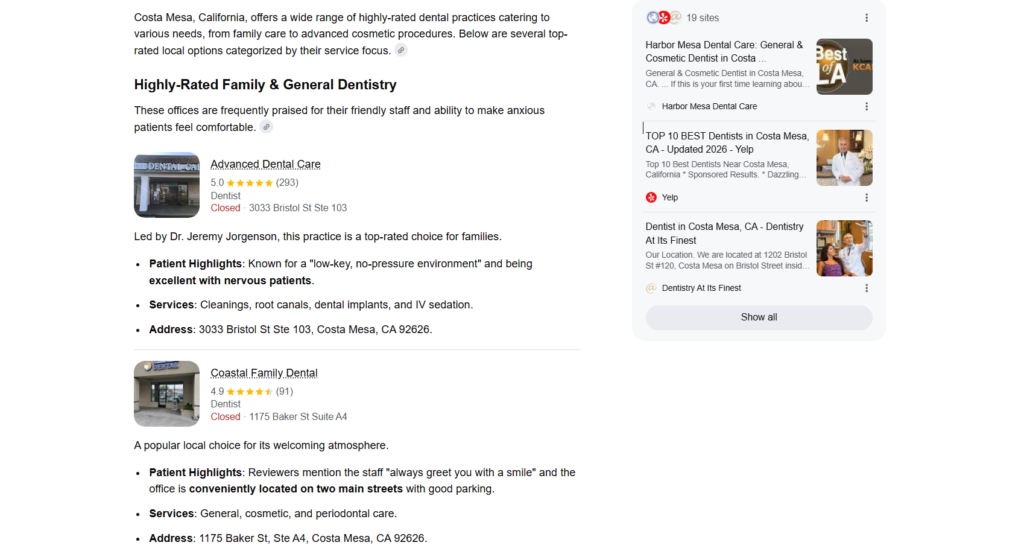
Here’s the clean version: the goal isn’t just to sit underneath an AI Overview. It’s to become the business or source those systems feel safe citing, summarizing, and recommending.
That’s the GEO piece in plain English. And the behavior change is already here. BrightLocal’s 2026 survey says use of generative AI tools for local recommendations jumped from 6% to 45% in a year, making AI the third most-used source for local recommendations behind Google and Facebook. BrightLocal’s AI/local guidance also says high-quality PR, brand mentions, and credible citations make AI more likely to surface a business.
So yes, mentions matter. Not just for SEO. For AI discovery too.
Do Social Signals and Paid Ads Matter for Local SEO?
Yes, when they’re used properly.
A minimum social presence still helps. Be findable. Link back to the site and profile. Show up when the brand is mentioned. Even if social isn’t a primary acquisition channel, businesses should maintain a basic presence where their community is active and pay attention to what’s being said.
Paid ads, on the other hand, should come after organic, local SEO, but they’re still useful.
In easier markets, solid local fundamentals can carry a lot. In harder ones, geotargeted ads, Google Ads, or Local Services Ads can help while the organic side matures. The important part is this: paid should support a strong local foundation, not hide a broken one.
Measure What Matters: ROI, Timelines, Quick Wins, and What to Fix First
Rankings alone aren’t enough. A serious local SEO setup should show what happens from visibility to revenue. You need to see rankings, booking flows, GBP interactions, CRM attribution, UTM-tagged URLs, everything.
The right model is simple:
- Profile visibility
- Profile action
- Landing page engagement
- Lead creation
- Booking
- Revenue
You should be able to see calls, bookings, website clicks, and direction requests from the profile itself, then track what happens after the click in analytics or a CRM.
UTMs are one of the easiest wins here. Without them, profile traffic gets lumped into generic organic reporting. With them, you can separate:
- Website-button clicks
- Booking-link clicks
- One office versus another
- One destination page versus another
What to Measure with Local SEO
The most useful metrics usually fall into three buckets:
Profile metrics
- Calls
- Website clicks
- Direction requests
- Booking clicks
Website metrics
- Landing-page sessions
- Mobile call clicks
- Form submissions
- Booking completions
- Conversion rate by page
Revenue metrics
- Qualified leads
- Booked appointments
- Closed revenue
- Revenue by location page
- Revenue by service page
Yes, rankings still matter. Just track them in a way that matches local reality. Geo-grid tracking, local pack visibility by area, and service-plus-city rankings tell you far more than one screenshot from one ZIP code.
Timeline-wise, meaningful gains usually take three to six months. SEO is slower than ads. But there’s an important nuance: if the foundations are messy, good fixes should usually create some movement in the first month. Bigger gains take longer because reviews, links, page strength, and reputation compound.
The Micro SEO Strategy
One of the smartest practical ideas here is Micro SEO. Don’t always start from scratch. Look for pages already ranking around positions 11 to 30 for high-intent terms. Those are often the easiest wins. Tighten the title tag, improve the intro, fix the heading structure, add proof, strengthen internal links, and support the page that’s already halfway there.
If rankings are stuck, fix the parts that remove the most doubt first:
- Google Business Profile completeness and category accuracy
- NAP consistency and duplicate cleanup
- Location pages and service pages
- Landing-page titles, headings, schema, map embeds, and CTAs
- Review flow, responses, photos, and local proof
- Authority through links, PR, publishing, and partnerships
- Attribution and revenue tracking
If you want quicker wins, start where the uncertainty is high and the fix is small:
- Wrong primary category
- Weak GBP landing-page link
- Inconsistent NAP
- Missing map embed
- Weak title tags
- Stale hours
- Duplicate listings
- No review ask
- A page stuck on page two with obvious on-page issues
- What not to do first:
- Publish ten weak blog posts
- Buy links to a weak homepage
- Spin up thin city pages
- Obsess over tiny technical details while the basics are still broken
Take Tiny Tooth as an example. If they wanted to improve their Local SEO they’d just need to fix a few quick things: the missing map embed, the title tag (no geographical keywords), the lack of localized headings, and category specify.
Conquer Local Google SEO Before You Conquer the World
Local SEO works best when it stops being treated like a checklist and starts being treated like a system that lines up:
- Your profile
- Your pages
- Your reviews
- Your citations
- Your links
- Your photos
- Your tracking
When those pieces back each other up, Google has less reason to hesitate, and customers have fewer reasons to bounce. The dentists that got the best results in our review weren’t doing a single magic trick. They were lining up the profile, page, NAP, categories, reviews, photos, links, and booking flow so Google and customers had fewer reasons to hesitate. That’s the real lesson. Local SEO works when the whole business looks easier to understand, easier to trust, and easier to choose.
Do that well, and you don’t just rank better. You turn local search into something a lot more valuable than traffic. You turn it into booked business.
If you need help getting those results, contact CrowdCreate to learn more about how we’ve helped local businesses like yours own their area of Google.
FAQs
How do you rank in the Google 3-pack?
By tightening the whole local entity, not one isolated signal. That means better profile setup, better categories, cleaner NAP, stronger location and service pages, healthier reviews, and more trust around the brand.
Can a service-area business rank without showing its address?
Yes, but it’s usually harder. A hidden-address service-area business can still rank if the profile is strong and the site, reviews, and citations are clear. It just has a weaker built-in place signal than a visible-address business.
Can you rank in nearby cities without an office?
You can compete there, especially through nearby-city or service-area pages and localized organic results. You usually won’t have the same map-pack advantage as a business with a real office in that city.
How many reviews do you need?
There isn’t a magic number. What matters is how your profile compares with the businesses already winning the market on count, freshness, detail, and response activity.
Does embedding a Google Map help local SEO?
It helps reinforce location clarity on the right pages, especially office-backed location pages and contact pages. It’s not a standalone trick. It works as part of a broader place signal.
What should you track to measure local SEO ROI?
Track the whole path: profile interactions, landing-page behavior, calls and forms, bookings, and revenue by page, service, or location where possible. Rankings matter. Revenue clarity matters more.
